
Category: Care & Maintenance | Audience: Homeowners
Introduction
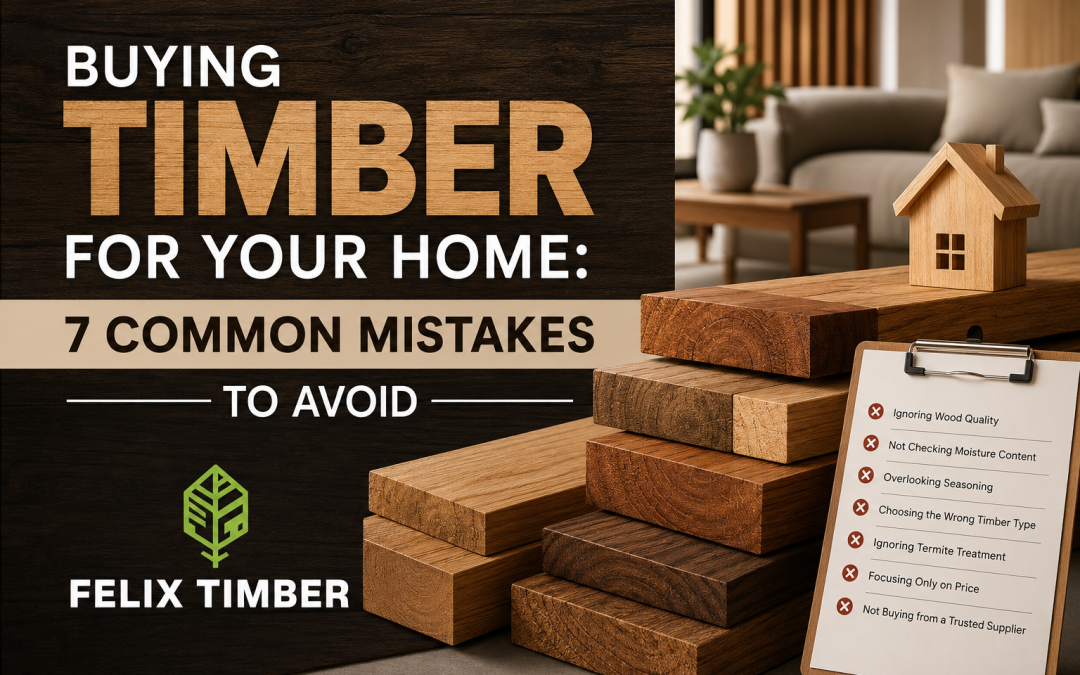
Buying timber for your home — whether for furniture, doors, flooring, or construction — is a significant investment. And like any significant investment, buying timber for your home is something where it is easy to make costly mistakes if you do not know what to look for. At Felix Timber, we speak with customers every day who have either made these mistakes elsewhere, or want to avoid them entirely by buying right the first time.
Here are the most common mistakes we see, and how to avoid them.
Mistake 1: Buying on Price Alone
This is the single most common mistake. Timber varies enormously in quality — and cheaper timber often costs more in the long run. Unseasoned wood warps after installation. Low-grade timber develops cracks. Sapwood attracts termites. The money saved upfront on cheap timber frequently disappears in repairs, replacements, or professional fixes within a few years.
The right approach: set a realistic budget for quality timber, and understand that the additional cost upfront is an investment in longevity and peace of mind.
Mistake 2: Not Asking About Seasoning
Timber must be properly seasoned (dried) before use. Unseasoned or green wood contains high moisture content, and as it dries after installation, it shrinks, warps, and can cause doors to stick, joints to open up, and furniture to develop cracks.
Always ask your supplier: has this timber been seasoned? How? For how long? At Felix Timber, our timber is properly seasoned before use in any project or product — but not all suppliers are as careful.
Mistake 3: Confusing Heartwood and Sapwood When Buying Timber for Your Home
Every timber tree has two zones: the heartwood (inner, darker, denser wood) and the sapwood (outer, lighter, younger wood). Heartwood is far more durable, resistant to moisture and insects, and stronger. Sapwood is significantly weaker and far more susceptible to termite attack.
When buying timber for your home — especially teak — check the cut faces of the wood. A large portion of pale, light-coloured wood is sapwood. For structural and furniture use, you want heartwood. Many suppliers mix heartwood and sapwood pieces without clearly distinguishing them.
Mistake 4: Buying a Veneer and Thinking It Is Solid Wood
In the furniture market particularly, teak veneer products are frequently sold as ‘teak wood furniture.’ A veneer is a thin slice of real teak (sometimes as thin as 0.5mm) glued over a substrate of MDF, plywood, or particleboard. The surface looks like teak. But the core is not.
How to tell the difference: solid wood is heavy for its size; veneer furniture is lighter. Solid wood has grain visible on all surfaces and edges; veneer ends are often capped with paper or thin strips that do not match perfectly. When in doubt, ask explicitly: is this solid teak or a veneer product?
Mistake 5: Ignoring the Grain Direction
For furniture and structural use, grain direction matters. Timber cut with grain running in the wrong direction relative to the load it will bear is significantly weaker. This is a technical detail that a good carpenter or timber supplier will understand — if your supplier cannot explain grain direction and why it matters for your application, that is a concern.
Mistake 6: Not Visiting the Yard
Buying timber without seeing it is like buying a house without visiting it. Photographs and descriptions cannot substitute for being in the yard, running your hands along the planks, checking for knots, checking for cracks, smelling the cut wood, and speaking directly with the team. At Felix Timber, we actively encourage customers to visit us in Panipat. You can see our stock, understand the grades, and make an informed decision.
Mistake 7: Underestimating What You Need
Always buy 10-15% more timber than your calculated requirement. Cutting waste, defective sections that must be discarded, and inevitable errors during carpentry all consume material. Buying exactly enough often means running short — and finding matching timber from the same batch later is not always possible.
Final Thoughts on Buying Timber for Your Home
Buying the right timber from the right supplier is genuinely not difficult — it just requires asking the right questions and buying from people who are transparent and knowledgeable. At Felix Timber, we have been working with teak for years and are happy to guide any customer through the selection process, whether you are buying a single door frame or timber for an entire construction project.
Come visit us. Ask us anything. We are here to help you get buying timber for your home right the first time.
Visit Felix Timber: www.felixtimber.com | Call: +91-8930000288